Monday, March 6, 2017

THE CENTRE CANNOT HOLD: A ROUGHER BEAST SLOUCHES

As the Author has noted, people turn to poetry in times of crisis. In an earlier post, the Author referred to W. H. Auden's poem "September 1, 1939" in the wake of 9-11.  And the Author pointed out the prescient poem "Dover Beach," by the 19th century British poet Matthew Arnold, in an earlier post.

In the last few months W.B. Yeat's poem "The Second Coming" has been quoted more than it has ever been in recent times. In the wake of Brexit and and the US election, indeed the Centre may not Hold. And when the Author sees the green-haired strut up the gangway, he sees the Rough Beast.  The old order is collapsing and the worst, unshaven, unkempt, uncoiffed,  sidle in under cover of disarray

It's f***in' bad,  folks. We find solace, hope, and eventual renewal in the Desert of the Real.


The Second Coming
Turning and turning in the widening gyre
The falcon cannot hear the falconer;
Things fall apart; the centre cannot hold;
Mere anarchy is loosed upon the world,
The blood-dimmed tide is loosed, and everywhere
The ceremony of innocence is drowned;
The best lack all conviction, while the worst
Are full of passionate intensity.

Surely some revelation is at hand;
Surely the Second Coming is at hand.
The Second Coming! Hardly are those words out
When a vast image out of Spiritus Mundi
Troubles my sight: somewhere in sands of the desert
A shape with lion body and the head of a man,
A gaze blank and pitiless as the sun,
Is moving its slow thighs, while all about it
Reel shadows of the indignant desert birds.
The darkness drops again; but now I know
That twenty centuries of stony sleep
Were vexed to nightmare by a rocking cradle,
And what rough beast, its hour come round at last,
Slouches towards Bethlehem to be born?

Wednesday, March 1, 2017

Don't Confuse me with the Facts. No Longer just One Political Party's Mission Statement.

It's often stated, with a grizzled level of accuracy, that America is living in a post-factual age. This has been noted for a few years, when the concept of "truththiness" and the claim by political operatives that they could create their own false reality by repeating planks of perjury.

It is also been frequently observed that when post-factual fabualists are confronted with facts they react in an utterly counterintuitively manner. Rather than act like a rational, thinking sentient organism (like a maze mouse receiving a shock on the nose and changing paths), they double down on dumbness. Alternate facts aren't even enough for these idiotlogues. We are dealing with chuks that are not intelligent enough to operate the electric eye flush sensor in a nursing home restroom.

New research provides more evidence of this anti-reality cognitive reinforcement mechanism. In "There's an intriguing sociological reason so many Americans are ignoring facts lately" http://www.businessinsider.com/sociology-alternative-facts-2017-2, researchers demonstrate that people with hardened political beliefs are even less likely to correct their misconceptions when presented with the truth. The researchers stated:

Nyhan and Reifler found that how people responded to the factual corrections in the articles they read varied systematically by how ideologically committed they already were to the beliefs that such facts supported. Among those who believed the popular misinformation in the first place, more information and actual facts challenging those beliefs did not cause a change of opinion—in fact, it often had the effect of strengthening those ideologically grounded beliefs.  

 DON'T MAKE ME HAVE TO THINK ABOUT THIS...

One simple example was provided. The rates of violent crime and property crime have plummeted since 1993. Yet the percent of Americans that believe that the current year's crime rate is higher that last year's is consistently high, ranging from 84% in 1989 to 72% in 2016. 

So whether it is estimating crowds at presidential events or fear mongering about terrorist refugees coming to put super glue on VFW bar stools, don't bother with truth when lying might get you another Gallup point or two.

DEMOCRACY WILL DO WELL IN THE DESERT OF THE REAL. NOT SO WELL IN THE DESERT OF THE POST-KNOWLEDGE AGE UNDESIRABLES. (You've Been Warned. Many Times.)


Tuesday, February 14, 2017

The New Normal. Or Future Worse?

 As the American economy matures in an economically competitive world, Nominal and Real Economic Growth Rates have gradually decreased. It is often called the "New Normal." Several features are represented in this "New Normal." Business cycles are longer but with slower growth. And except for the Great Recession, in the main triggered by a failure to judiciously regulate the real estate and derivatives market, recessions are more shallow and shorter. With that said, here is this week's contribution to the debate.
Economic Development in the US: Looking Back 35 Years
America has experienced a Nominal (nominal means considering inflation) economic growth rate of 5.4%, on average. This also equates to an average of $9.5 billion in national output each year since 1980.  While these numbers may sound good to the average citizen, Real economic growth (growth adjusted for the rate of inflation) has been closer to 2.4% annually with real output of $3.7 billion each year.

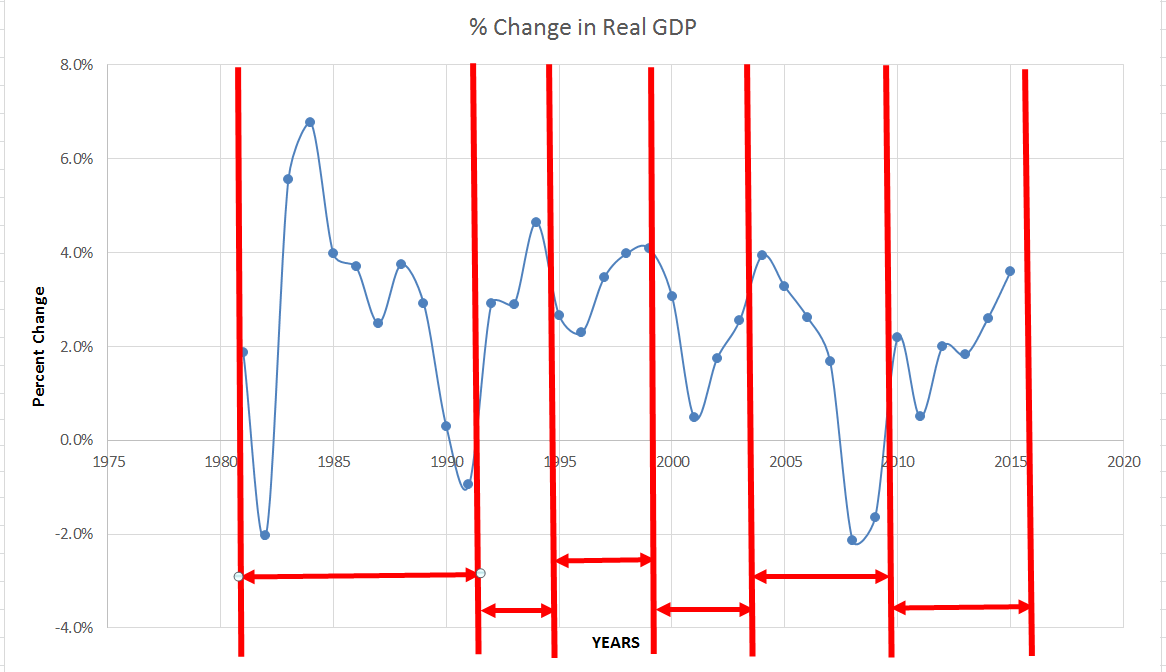
Recently, though, Americans have seen Real growth rates of 4% in 2015.  This number is an improvement over the historical average. To arrive at these figures, economists look at business cycles – recessions and expansions – to analyze and compare economic growth (see Graph 1).  
  
Graph 1Capture

Governments seeks to limit recessions and spur and prolong economic expansion. Various American presidential administrations have introduced initiatives and policies to improve the economy.  Recent action such as the American Recovery and Reinvestment Act or “Economic Stimulus Package” of 2009, was introduced in the wake of the 2008 collapse of the real estate market.

In reviewing the actions of various administrations over the past 35 years (Chart 1), business cycles appear to be getting longer.  For example, the Reagan administration had a two year peak to trough cycle. The Obama administration, by contrast, has produced economic growth for most of his presidential term. So let’s take a deeper look at the Real growth rate over the past 35 years. And let’s also look at some specific period(s) of time in the last 35 years.

Chart 1
US Presidents over the past 35 Years
Growth Rates (within Presidential Term)
Highest
Lowest
Reagan
6.8%
-2.0%
Clinton
4.7%
2.3%
GW Bush
3.9%
-2.1%
Obama
3.6%
-1.6%
HW Bush
2.9%
-0.9%

Presidents are all faced with different economic challenges and outside events that have great impact on economic growth. George W. Bush ended his eight-year term with the real estate market collapse in 2008 and Obama inherited that same economic mess. Reagan saw both high and low rates of growth, while Clinton came into office during a great expansion in computer technology followed by the dot.com boom and bust.

From some high rates of growth in the 1980s, rates of fluctuation in economic growth have flattened and declined somewhat over this period of time. And until the collapse of the real estate market in 2008, the economy has steered clear of major recessions and major declines in growth.  Overall, in this past 35 year period there have been six business cycles. These are shown, with their peaks and troughs, in Graph 1.

If we look at the secular trend over our period of time, Real growth rates have slowed in volatility.  This is in large part impacted by automatic stabilizers like the welfare system, unemployment insurance and the personal income tax system.  Automatic stabilizers counterbalance instabilities in the economy activity without direct involvement by policymakers.  In 2000, a study done by Alan Auerbach and Daniel Feenberg published in their article “The Significance of Federal Taxes as Automatic Stabilizers" in the Journal of Economic Perspectives, assessed that reduced income and payroll tax balances about 8% of any GDP decline.  Unemployment insurance payouts further stabilizes GDP.  Estimates indicate that unemployment payouts are 8 times more effective per dollar in economic stimulus relative to the same amount being saved rather than being put in circulation

Economic growth and contraction were also affected by Federal Reserve Board policies during this period of time. In 1979 incoming Federal Reserve Board Chairman Paul Volcker faced an economy with runaway inflation which peaked in March of 1980 at 14.8%. Contractionary monetary policy was put in place to cool inflation. Fed Fund rates were raised to 21.5%. These actions by natural result triggered a short, very deep recession in 1981-1982 with unemployment over 10%.  But when the economy came out of this recession, inflation stabilized and a more stable economy that followed historical business cycle emerged.  
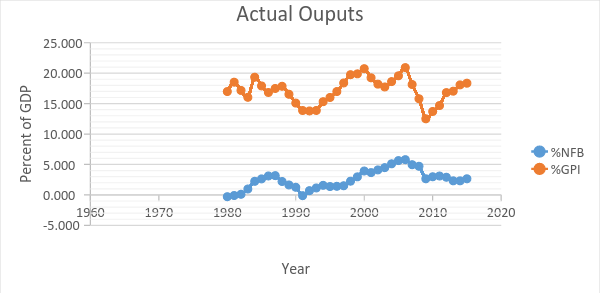
Another economic trend emerged during this 35-year period, increasing trade deficits. From 1980 to 1991, trade deficits remained benign. But in 1997 trade deficits rose steeply, peaking in 2006, but never returning to their previous levels.
These trade deficits are in effect placing a claim against future economic output to maintain current output.   Eventually, the interest paid on this debt will overtake America’s ability to maintain this pattern of borrowing.
These trends are not sustainable. Employing regression analysis upon the current account deficits and foreign borrowing demonstrates this. In simple terms, the US is living beyond its means. 
If we examine these trends by comparing Net Foreign Borrowing (NFB) with Gross Private Investment (GPI), we see that NFP exceeds GPI by roughly 15% over our 35 year period as seen in Graph 2.
Graph 2
Going forward, what sources of economic growth and public policies could raise GPI and lower NFB? Technological progress can be a major driver of economic growth. Public policies that can drive economic growth can be effective are policies that provide appropriate education and encourage Research and Development(R & D), in industry and academia. These R&D advances will increase productivity, advance technology and provide positive externalities for the US economy.

Written by Alison Blodgett, Eric Hoover, Jeffrey Wilder and Julie Feightner. 

Added by Rob Feightner: Blathering about "brangin' the jawbs bak," protectionist trade policies and hog trough tax policies that lower the marginal rate for rich LLC owners to an amount lower than their highly compensated employees will increase the deficit to records only Arthur Laffler could love. This deficit and the exploding debt may well knock US treasuries off their spot as the universal risk free rate of return. And raise the cost of borrowing in the US. But the Mezcuns will pay for it.

US manufacturing is operating at record levels. Manufacturing just needs fewer workers as automation and robots supplant humans. This trend is indefagatible and irreversible. Many fast food workers, one of the last industry hiring great amounts of unskilled labor, will be automated. And automation will hit healthcare with patient care robots. Not everyone can get a job selling health insurance across state lines, teaching in privatized schools, or marking up the price of Medicare vouchers.

Ironic isn't it, that just as the last few threads of the American safety net are being ripped down, labor dislocation on the scale of the Industrial Revolution lurks not afar on the darkling plain. 

THE DESERT OF THE REAL IS BACK! NOT EVEN A WALL AND RUSSIAN COLLABORATORS CAN RESTRAIN IT.

Saturday, December 24, 2016

Confusing Alarms of Struggle and Flight

In times when the bedrock principles of the nation are eroding and a darkling peril destroys the indeterminate future, some Americans find solace and threads of comprehension in poetry.

After the 9.11 attacks on the Twin Towers, W.H. Auden's poem "September 1, 1939 " was rediscovered. It reflects upon the slakeless insanity let slip upon the world. Good men had done nothing. The worst, given license in the shade cast by a tyrant, now may thieve with meretricious euphoria.

In 1939 the world was enveloped by insanity and the US on a deferment to be counted in days.

So it is at our gates again.

Here is the poem "Dover Beach" written by Matthew Arnold in 1867,  about one hundred fifty years ago.

The sea is calm tonight.
The tide is full, the moon lies fair
Upon the straits; on the French coast, the light
Gleams and is gone; the cliffs of England stand,
Glimmering and vast, out in the tranquil bay.
Come to the window, sweet is the night-air!
Only, from the long line of spray
Where the sea meets the moon-blanched land,

Listen! you hear the grating roar
Of pebbles which the waves draw back, and fling,
At their return, up the high strand,
Begin, and cease, and then again begin, 
With tremulous cadence slow, and bring 
The eternal note of sadness in.

Sophocles long ago
Heard it on the Aegean, and it brought
Into his mind the turbid ebb and flow
Of human misery; we
Find also in the sound a thought,
Hearing it by this distant northern sea.

The Sea of Faith
Was once, too, at the full, and round earth’s shore
Lay like the folds of a bright girdle furled.
But now I only hear
Its melancholy, long, withdrawing roar,
Retreating, to the breath
Of the night-wind, down the vast edges drear
And naked shingles of the world.

Ah, love, let us be true
To one another! for the world, which seems
To lie before us like a land of dreams,
So various, so beautiful, so new,
Hath really neither joy, nor love, nor light,
Nor certitude, nor peace, nor help for pain;
And we are here as on a darkling plain
Swept with confused alarms of struggle and flight,
Where ignorant armies clash by night.
 
Merry Christmas from a day not unlike December 25th, 1941. 


Sunday, December 11, 2016

The Fuhrer Finds out that no "Beavis and Butthead do Christmas" is, uh, huh, huh is coming. Uh, huh, huh, he said...

Rituals are important in the Christmas season. TV cartoons,  North Pole narratives and for the socially challenged, watching the Beavis and Butt-Head do Christmas. Beavis and Butt-Head do Christmas features the idiot savants parodying two Christmas Classics, The Christmas Carol and It's a Wonderful Life.

Unknown to everyone except Hitler's inner circle, the Furher cherished his yuletide viewing of Beavis and Butt-Head Do Christmas. But there is just one problem...

https://www.youtube.com/watch?v=4fHN7CuY6_Q


The title of this Blog, “Desert of the Real Economics”, comes from the 1998 film “The Matrix”. The world in the Matrix is a Simulacrum, a computer–generated illusion. It only “looks” and “feels” like the late 20th century. Instead, human beings are enslaved in tanks of fluid, wired to the Matrix. Humans are the ultimate wetware, the Meatmen of the Matrix. Also, readers steeped in post-structuralist philosophy may recognize the title as a paraphrase of a quote in Jean Baudrilliard’s 1981 book, “Simulacra and Simulacrum.” 

Thursday, November 17, 2016

CAN LIFE EXIST WITHOUT OPTIONS?

FINANCIAL GENIUS IS LEVERAGE IN A RISING MARKET

“FINANCIAL GENIUS IS LEVERAGE IN A RISING MARKET”, John Kenneth Galbraith

Who can argue with that statement? But how can we make leverage work?

There are many ways to leverage investments. Margin trading accounts, Rydex index leveraged funds, and options, for example. Some readers have seen examples of how options can leverage an investment and provide a greater return than ownership of the underlying stock. Let’s review how options can make leverage work:

We have $8,000 to invest. Our research shows that DUC stock is likely to rise in price after its good earnings report is released in next week. DUC is currently selling for $80 per share and we predict it will rise to $84 after the earnings report comes out. To profit from this increase in price, we have a couple of choices:

Buy 100 shares of DUC at $80 per share. If DUC rises to $84 next week, we will do well, making a $400 gain, or a 5% return in a week. ($84 per share-$80 per share = $4 per share * 100 shares = 400. 4/80 = 5% return.)

Buy 40 option call contracts at $200 per 100 share contract. These call options on DUC have a strike price[i] of $80. Our research into this DUC call option tells us that with each increase of $1.00 in the price of DUC stock, the call option will also rise $1.00, or $100 per 100 share contract.[ii]

So when DUC stock rises to $84 per share, each call option contract will rise from $200 per contract to $600 per contact. ($4 per share call * 100 share per contract = $400.) But it gets better, much better. Since we bought 40 contracts with our $8,000, our contracts are worth $16,000, for a return of 100%.

This is an extreme example, to be sure. Over the next few weeks the Author will examine uses of options and option strategies. They have many uses in a portfolio and we will explore some ways that you can make options work for you.

YOUR CHOICES ARE YOUR OWN IN THE DESERT OF THE REAL!

[i] There are three major features to an options contract. The underlying stock, the strike price and the expiration date. DUC is the underlying stock. The strike price is the exercise price of the option. In this case, the call gives us the right to buy $ DUC at $80, regardless of the market price. Finally, all option contracts are limited in time. They expire on a fixed date.
[ii] Because this call rises $1.00 per call as the underlying stock rises $1.00 per share, the stock is said to have a delta of 1.00. Delta is a measure of the rate of change. In the option universe, delta compares movement in an option to movement of the underlying stock. If the call moved $.75 for each $1.00 movement of the underlying DUC stock, then the delta would be .75. .75/1.00 = .75. If the call moved 2.00 for each $1.00 movement of the DUC stock, then the option would have a delta of 2.00.

OLDIES BUT GOODIES-THE DESERT OF THE REAL ECONOMICS STANDARDS

In mid-August of 2008, the World Economy almost melted down. The Great Recession could have been the Pretty Darn Bad Depression. Not as bad as 1929, but still bad.

Never Submit. Always Resist. Never Forget.

http://desertoftherealecononomicanalysis.blogspot.com/2010/10/repost-from-9202008-how-soon-we-forget.html

Sage Words from An Idiot Savant who has got the Idiot part down pretty well.

All week the Author has been asking the question: "What crashed the financial markets so fast. "Through which gate did the Vandals enter?”

The financial decline has been festering for a long time. Real estate reeling, mortgages in meltdown. Liquidity lacking. But what changed so quickly and so ominously?

Or what, as the New York Times article “Congressional Leaders Stunned by Warnings,“ spooked the Senators speechless?

From the NYT article of today (9.20.2008):

It was a room full of people who rarely hold their tongues. But as the Fed chairman, Ben S. Bernanke, laid out the potentially devastating ramifications of the financial crisis before congressional leaders on Thursday night, there was a stunned silence at first.

Mr. Bernanke and Treasury Secretary Henry M. Paulson Jr. had made an urgent and unusual evening visit to Capitol Hill, and they were gathered around a conference table in the offices of House Speaker Nancy Pelosi.

“When you listened to him describe it you gulped," said Senator Charles E. Schumer, Democrat of New York.

As Senator Christopher J. Dodd, Democrat of Connecticut and chairman of the Banking, Housing and Urban Affairs Committee, put it Friday morning on the ABC program “Good Morning America,” the congressional leaders were told “that we’re literally maybe days away from a complete meltdown of our financial system, with all the implications here at home and globally.”


TO QUOTE FRED WILLIARD, “WHA’ HAPPENED?”

John Mauldin publishes several investment newsletters. In September 19th’s Newsletter entitled “Betting on Financial Armageddon”, Mauldin swings the spotlight onto the padlocked commercial paper market. (Commercial paper is a short-term unsecured promissory note that large institutions use to borrow and lend cash to other institutions.)

Want to see in graph form how bad it got and what spooked Paulson, Bernanke and company to act so quickly? Look at these graphs from my friends at Casey Research. 30day commercial paper went to 5% from 3% a week ago. The market was literally freezing. And the amount of paper issued is in free fall. Commercial paper is the life blood of the financial and business world. Without it commerce will soon grind to a halt.

Two charts posted above this article demonstrate the precipitous decline in the commercial paper market.

The Congressional leaders quoted in the New York Times above make similar reference to a strangling credit market:

Although Mr. Schumer, Mr. Dodd and other participants declined to repeat precisely what they were told by Mr. Bernanke and Mr. Paulson, they said the two men described the financial system as effectively bound in a knot that was being pulled tighter and tighter by the day.

“You have the credit lines in America, which are the lifeblood of the economy, frozen.” Mr. Schumer said. “That hasn’t happened before. It’s a brave new world. You are in uncharted territory, but the one thing you do know is you can’t leave them frozen or the economy will just head south at a rapid rate.”


GOLDEN PARACHUTING INTO THE ABYSS

Currently, and over the next few days, the Congress and the outgoing administration will be negotiating over the terms of a financial “rescue” plan that has an undetermined chance of indeterminate success over an undefined time frame.

As the damage appears and the plan develops, the Author will continue to post, analyze, and prognosticate.

WE HOPED THAT IT WOULD NOT HAVE COME TO THIS IN THE DESERT OF THE REAL!